The Artist
Biography
Born 1940 · West Bengal, India · Painter, printmaker, and one of the most significant artists of post-independence India.
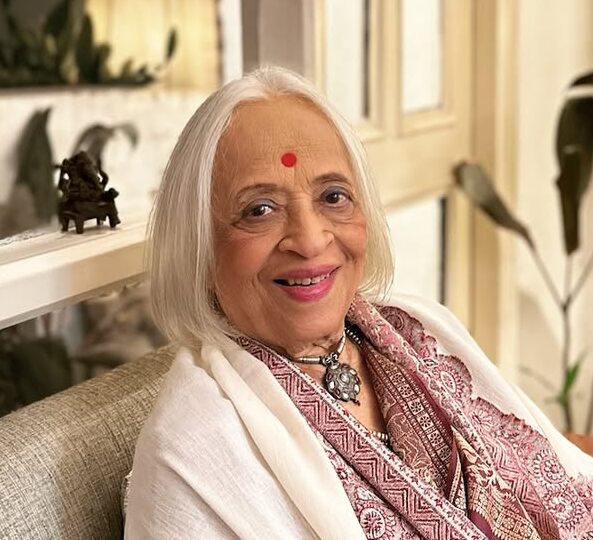
Anjolie Ela Menon · New Delhi
Overview
A Vision Shaped by
Two Worlds
Anjolie Ela Menon occupies a singular position in Indian art — a painter whose work is immediately recognisable yet endlessly mysterious. Her canvases are populated by haunting women: frontal, still, and luminous, rendered in the warm darkness of ochre and sienna on masonite boards worked with pumice and varnish until they crack and age like the walls of ancient churches.
Born in 1940 in West Bengal, she was educated at Miranda House, University of Delhi, before travelling to Paris in the late 1950s to study printmaking at the legendary Atelier 17 under Stanley William Hayter — a studio that had shaped the practice of Picasso, Miró, Giacometti, and Pollock. The experience gave her a rigorous understanding of surface, texture, and the expressive power of the mark that would define her painting for the next six decades.
Returning to India, she forged a style that drew on Byzantine iconography, medieval fresco, Sanskrit text, and the Indian miniature tradition — yet belonged entirely to her. Her paintings hang in the National Gallery of Modern Art, Bharat Bhavan, and private collections across four continents. She is, without question, one of the defining figures of post-independence Indian art.
Born
1940, West Bengal
Medium
Oil on Masonite
Training
Atelier 17, Paris
Style
Byzantine Figurative
Based in
New Delhi, India
Active since
c. 1960
In Her Own Words
The Artist Speaks
"I paint the same woman over and over again — she is every woman, she is me."
On her recurring subject
"My paintings are not about beauty. They are about the human condition — longing, solitude, the passage of time."
On her artistic intent
"The surface of a painting should carry the memory of its making. I want you to feel the time that went into it."
On technique and process
"I have always been drawn to the sacred — not religion, but the quality of attention that the sacred demands."
On spirituality in her work
"Masonite does not forgive. You cannot paint over a mistake and pretend it did not happen. The board remembers everything."
On working with masonite
"Paris gave me rigour. India gave me soul. The paintings live in the space between."
On her dual artistic inheritance
Life & Work
A Life in Chronology
1940
Born in West Bengal
Anjolie Ela Menon is born in West Bengal, India. Her father, a civil servant, and her mother, a woman of considerable cultural refinement, nurture her early love of art, literature, and music.
1950s
Education at Miranda House, Delhi
She studies at Miranda House, University of Delhi — one of India's most distinguished women's colleges — where her artistic sensibility deepens alongside a rigorous academic education in the humanities.
1959–61
Paris — Atelier 17
Menon travels to Paris and studies printmaking under the legendary Stanley William Hayter at Atelier 17 — the most influential printmaking studio of the twentieth century, which had shaped the practice of Picasso, Miró, Giacometti, and Pollock. The experience gives her a profound understanding of surface, texture, and the expressive power of the mark.
Early 1960s
Return to India — Finding Her Voice
Back in India, she begins working in oil on masonite — a choice that will define her practice. She treats the hard board with pumice and varnish, building up surfaces that crack and age like ancient frescoes. The Byzantine frontality of her figures, the warm darkness of her palette, and the psychological intensity of her gaze emerge as a fully formed style.
1970s
Recognition & Major Works
Works such as "The Bather", "Mother and Child", and "Woman with a Lamp" attract serious critical attention. She exhibits widely across India and internationally, establishing herself as a singular voice in Indian contemporary art. Critics begin to call her India's First Lady of Art.
1980s
International Exhibitions
Menon exhibits across Europe and the United States, including the Festival of India at the Royal Academy of Arts, London (1986). Her work enters major institutional collections: the National Gallery of Modern Art in New Delhi and Mumbai, and Bharat Bhavan in Bhopal.
1990s
Mature Period — Sacred & Profane
Her work deepens in its engagement with devotional imagery — Sanskrit text, Christian iconography, and Hindu symbolism appear on and within her figures. She begins incorporating gold leaf and script into her surfaces, creating paintings that function as secular icons.
2000
Padma Shri
The Government of India awards her the Padma Shri — one of the nation's highest civilian honours — in recognition of her distinguished contribution to Indian art over four decades.
2007
Chevalier, Ordre des Arts et des Lettres
The French government bestows upon her the Chevalier dans l'Ordre des Arts et des Lettres — Knight of the Order of Arts and Letters — one of France's most prestigious cultural honours, awarded to individuals who have made a significant contribution to the enrichment of French culture or to the arts and literature more broadly.
2007
Lalit Kala Akademi Fellowship
The National Academy of Art confers upon her its highest honour — the Lalit Kala Akademi Fellowship — recognising a lifetime of extraordinary artistic achievement and her foundational role in shaping the course of Indian contemporary painting.
2019
Timeless — A Retrospective
The National Gallery of Modern Art, New Delhi, mounts a landmark retrospective of her work — "Timeless" — featuring over 80 paintings spanning six decades. The exhibition confirms her place as one of the defining figures of Indian art.
Present
A Living Legacy
Now in her eighties, Anjolie Ela Menon continues to paint from her studio in New Delhi. Her work remains in active dialogue with collectors, curators, and a new generation of Indian artists who look to her as a foundational figure — proof that a singular vision, pursued with absolute commitment, endures.
Artistic Lineage
Influences & Inspirations
Byzantine Art
The frontal, hieratic quality of Byzantine icons — their stillness, their refusal of perspective, their spiritual weight — permeates every canvas. Menon absorbed this visual language during her travels in Europe and made it entirely her own, transplanting its devotional intensity into a secular, deeply personal context.
Stanley William Hayter
Her mentor at Atelier 17 in Paris taught her the discipline of printmaking and the expressive power of surface texture. Hayter's insistence on the physical intelligence of the hand — the mark as thought — shaped Menon's approach to oil on masonite, where the surface is never merely support but active participant.
Medieval Frescoes
The cracked, weathered surfaces of her paintings deliberately evoke the walls of medieval churches — as if her figures have always existed, waiting to be uncovered rather than created. She achieves this through pumice, varnish, and patient reworking, building up layers that carry the memory of their making.
Indian Miniature Tradition
While her training was Western, the intimacy and emotional intensity of Indian miniature painting runs beneath the surface of her work — a quiet inheritance she never abandoned. The compressed space, the psychological directness, and the use of decorative elements as carriers of meaning all speak to this lineage.
Sanskrit & Sacred Text
In her mature work, Sanskrit script appears as embellishment and meaning simultaneously — inscribed on the bodies of her figures, traced in gold across their surfaces. Language becomes ornament; the body becomes manuscript. This synthesis of the verbal and the visual is one of her most distinctive contributions.
The Female Figure
Menon's subject is, above all, the woman — solitary, frontal, and luminous. She has painted the same figure for sixty years, finding in her an inexhaustible reservoir of meaning. "She is every woman," Menon has said. "She is me." This sustained, obsessive attention to a single subject is itself a form of devotion.
Honours
Recognition
Padma Shri
Government of India
Chevalier, Ordre des Arts et des Lettres
Republic of France
Lalit Kala Akademi Fellowship
National Academy of Art, India